
SSG · Media Literacy & Disinformation
Digital Frontiers: Gen Z and Social Media in the 2026 US Midterms
Written by: Gajur Memeti Fourth-year student of International Communication, Faculty of Languages, Cultures and Communication, South East European University (SEEU). Intern at the Media Literacy and Disinformation Research Cluster (MeDisInfo), Social Sciences Research Group, Max van der Stoel Institute (MVDSI). Tetovo, November 2026
How Campaigns Reached Young Voters
Generation Z has become an increasingly important group in American elections. As younger voters spend more time on digital platforms, political campaigns have had to adapt the way they communicate with them. The 2026 US midterm elections provided another example of how social media has become an important part of modern political campaigning.
Unlike previous generations, many young voters encounter political information through TikTok, Instagram, YouTube, and other digital platforms rather than through traditional television news or printed newspapers. In this digital ecosystem, political content now appears alongside entertainment, personal experiences, and everyday discussions. As a result, campaigns have increasingly turned to short videos, online creators, and digital advertising to reach younger audiences.
This change can be connected to W. Russell Neuman’s discussion of the “paradox of profusion” in The Digital Difference. Neuman examines how the growing amount of information in the digital environment creates new challenges for the way people select and pay attention to different messages. Although people have access to more information, this does not mean that every message receives their attention.
This concept ties directly into the “attention economy,” which describes how attention becomes a valuable and limited resource in an environment filled with information. For 2026 campaigns, cutting through the noise required much more than standard ads. it demanded native, platform-specific content. This perspective also highlights a central challenge of digital communication: as information becomes increasingly abundant, audiences have limited attention to devote to individual messages. In simple terms, when people are surrounded by large amounts of content, different messages compete to be notice.
These perspectives are particularly relevant to the 2026 US midterm elections. Political campaigns used viral videos, influencers, and paid social media advertising to attract younger audiences in an increasingly crowded digital environment. However, attracting attention online does not necessarily mean changing someone’s political opinions or encouraging them to vote.
With this in mind, this case study examines how political campaigns and civic organizations used social media to reach young voters during the 2026 US midterms. It focuses on the role of influencers, digital voter information, and AI-generated political content. It also raises an important question: although social media can increase political awareness and engagement, does it actually encourage young people to participate in elections?
The study draws on secondary research, including CIRCLE election estimates, Pew Research Center survey findings and reporting on digital campaign strategies. It examines selected cases of political communication and distinguishes online reach from voting preferences and electoral participation. It does not establish that social media exposure caused particular voting decisions. For statistical comparisons, “young voters” refers to adults aged 18–29, CIRCLE’s reported age group, rather than an exact definition of all members of Gen Z.
The Shift in Youth Media Consumption
Digital platforms have changed how young people follow politics and engage with election campaigns. Social media is no longer just a place to find information but also a space where young people share opinions, discuss political issues, and engage with political content alongside entertainment, personal experiences, and everyday life topics. This has also changed how political parties and candidates communicate, as they increasingly use more direct, creative, and engaging ways to connect with younger voters.
According to Katerina Eva Matsa, 39% of Americans aged 18 to 29 regularly get news from TikTok. This figure demonstrates how important digital platforms have become in the everyday information habits of younger audiences.
These platforms also change the way political information is presented. Instead of reading a complete news article, users may receive information through a short video, a creator’s explanation or a discussion in the comments section. As a result, political communication is no longer limited to politicians, journalists and official campaign accounts. Online creators have also become important voices in political discussions.
This development creates new opportunities for political campaigns. By communicating through familiar platforms and personalities, political organizations can reach young audiences in a more accessible and informal way. However, it also raises questions about the reliability of information and the influence of algorithms on what young people see.
Youth Voting Patterns in the 2026 Midterm Elections
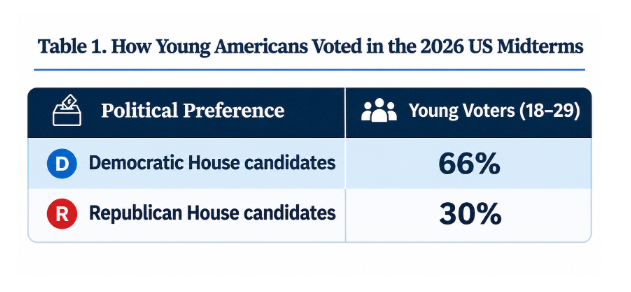
Table 1. How Young Americans Voted in the 2026 US Midterms. Source: Author-created visualization based on CIRCLE (2026a), using NORC Civic Health & Elections Project preliminary estimates.
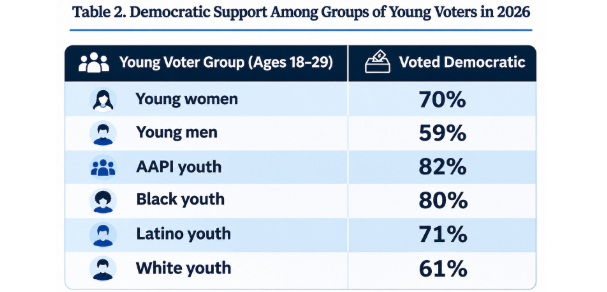
Table 2. Democratic Support Among Groups of Young Voters in 2026. Source: Author-created visualization based on CIRCLE (2026b), using NORC preliminary estimates.
As illustrated in Table 1, The results indicate that young voters strongly preferred Democratic U.S. House candidates in the 2026 midterms. As CIRCLE states, 66% of voters aged 18–29 supported Democrats, compared with 30% who supported Republicans. Furthermore, demographic breakdowns in Table 2 show that support varied by gender and race, with young women and minority youth registering the highest margins for Democratic candidates. Support varied by gender and race or ethnicity, with 70% of young women and 59% of young men voting for Democratic House candidates. These preliminary figures describe voting patterns, but do not establish that social media campaigning caused those choices.
Youth turnout is a different measure from party preference. CIRCLE estimated that 27% of eligible Americans aged 18–29 voted in the 2026 midterms, broadly matching its early 2022 estimate. The 2026 figure is preliminary, with an estimated margin of error of ±2 percentage points. It cannot show by itself whether social media encouraged people to vote.
Why the Youth Vote Shifted Toward Democrats in 2026
The 2026 US midterm elections showed a noticeable change in young voters’ political preferences compared with 2024. According to CIRCLE, Democratic candidates held a 36-percentage-point advantage among young voters in the U.S. House elections in 2026, compared with a 14-point advantage in 2024. Although 2024 was a presidential election year, voters also elected members of the House of Representatives, making it possible to compare support for House candidates across the two elections. The figures come from different election-year sources and should be interpreted cautiously. This shift does not necessarily mean that the same young voters changed their political views, since different groups may have participated in each election.
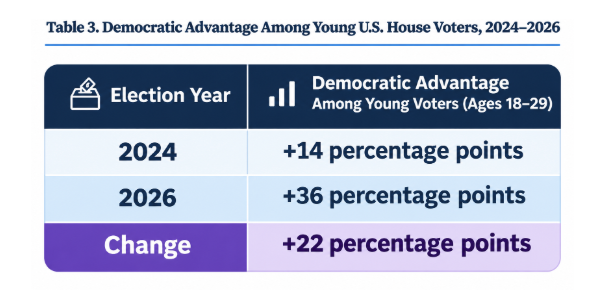
Table 3. Democratic Advantage Among Young U.S. House Voters, 2024–2026. Source: Author-created visualization based on CIRCLE (2026d); 2024 margin cited from Edison Research, 2026 from NORC.
One primary driving factor was the economy. Issues such as the cost of living, employment, and housing were major concerns for young Americans. According to Alec Dent, Democrats focused their campaign messages on economic issues, including inflation and housing costs, to connect with younger voters. Dissatisfaction with the country’s political direction may also have contributed to their voting decisions.
At the same time, Democrats made changes to their communication strategies. As reported by Dent and Merica, the party placed greater emphasis on digital platforms, content creators and messages addressing the everyday concerns of younger voters. Rather than relying only on traditional political advertising, campaigns increasingly used short videos and online content to reach Gen Z.
However, the shift cannot be explained by social media alone. Economic concerns, political dissatisfaction and differences in who participated in the election may also have contributed to the results. This suggests that digital campaigning was one part of a broader political and social context.
How Campaigns Reached Young Voters in 2026
During the 2026 US midterms, political campaigns increasingly used digital communication strategies to reach younger audiences. Short-form videos, social media creators and online discussions became important tools for attracting attention and potentially encouraging political participation.
One example was the Democratic National Committee’s efforts to reach young voters through online creators and social media content. According to Dent and Merica, the Democratic National Committee (DNC) reported that creators participating in its programme had a combined following of more than 75 million, while content produced using material from the party’s accounts received more than 100 million impressions between mid-2025 and mid-2026. These are measures of distribution and potential exposure, not of unique young voters or proven persuasion.
This approach shows how political organizations have started to move beyond traditional campaign advertisements. Instead of communicating only through official accounts, they increasingly use creators who already have established audiences and understand how to communicate on digital platforms. Short videos, political discussions and content adapted to popular online trends can make political messages more familiar to younger users.
Another example was TikTok’s partnership with Democracy Works for the 2026 US elections. Through TikTok’s Elections Center, users could access information about voter registration, polling locations, early voting and voting requirements. This initiative aimed to make authoritative election information easier to find through the platform.
These initiatives demonstrate that social media can serve purposes beyond political promotion. It can also provide practical information and help young people understand how to participate in elections.
However, reaching young people online does not automatically mean that they will vote. The effectiveness of digital campaigning cannot be judged only by how many people see political content; evidence about subsequent action is also needed.
Actual Cases of Political Campaigning: AI Use, Organic Virality, and Paid Promotion
The 2026 US midterm elections demonstrated how political campaigns used social media in different ways, combining viral content with paid digital advertising to attract attention and communicate with voters.
One such case of viral campaign content was an AI-generated satirical/parody video shared by Republican Tennessee gubernatorial candidate Marsha Blackburn in October 2026. The video recreated Kendrick Lamar’s “Not Like Us” Super Bowl performance as a form of political commentary and attracted more than 2.1 million views on X within two days. Although it received considerable attention, many online reactions were negative. The case illustrates how a political video can circulate through public reactions, criticism and online sharing, although the extent of unpaid distribution remains unclear. It also demonstrates that widespread visibility does not necessarily translate into positive public engagement or political suppor according to Christopher Wieduwilt.
A different approach was used by Democratic Michigan Senate candidate Abdul El-Sayed, whose campaign invested heavily in paid social media advertising. As indicated by Lucy Greider, approximately 94% of the campaign’s advertising spending during Sensor Tower’s September 1–October 20 analysis period went to Facebook and Instagram. The report notes that impressions on those platforms typically cost less than on traditional television. A concrete example of the campaign’s paid digital content was a sponsored Meta advertisement documented by Middle Seat, featuring Barack Obama and Kamala Harris alongside El-Sayed and encouraging voters to participate in the November 3 election. This case illustrates a strategy focused heavily on paid digital distribution; the data do not establish how many Gen Z voters saw the ads or whether their preferences changed.
These examples highlight two different approaches to political campaigning. While Blackburn’s video attracted attention through online circulation, El-Sayed’s campaign placed much of its advertising budget on social platforms. Both show the importance of digital visibility in elections. However, online reach and advertising exposure do not necessarily translate into political support or electoral participation among Gen Z voters.

Figure 1. Frame from Marsha Blackburn’s AI-generated “Not Like Us” campaign video (October 2026). Source for discussion: Wieduwilt (2026). Original campaign post.
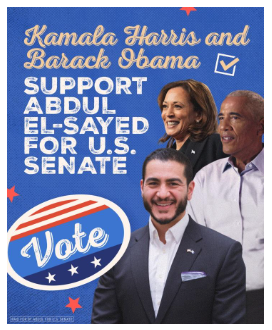
Figure 2. Paid Meta advertisement from Abdul El-Sayed’s 2026 Michigan U.S. Senate election campaign, featuring Barack Obama and Kamala Harris. Image reproduced from Middle Seat (n.d.), Abdul El-Sayed Digital Persuasion. The advertisement is presented by the agency as an example of the campaign’s paid digital promotion.
Challenges: AI-Generated Content and Political Misinformation
The growing use of artificial intelligence in political campaigns has raised concerns about the reliability of information shared on social media. While AI offers new ways to create and distribute political content, it can also make it more difficult for audiences to distinguish between authentic and manipulated information.
Based on Loreben Tuquero reporting for PolitiFact, findings from the Wesleyan Media Project show that approximately 300 political advertisements were generated or enhanced using AI during the 2026 election cycle. Around $187 million was spent promoting these advertisements across digital platforms and television.
However, not all AI-generated political content is misleading, as the technology can also be used for creative and legitimate campaign purposes.
For young audiences who often encounter political information through short videos and social media posts, identifying whether content has been artificially generated or manipulated can be particularly important when evaluating political messages.
These challenges highlight the importance of transparency, responsible political communication and media literacy in helping voters critically evaluate the information they encounter online.
Lessons for the Western Balkans and South East Europe
The developments observed during the 2026 US midterms also raise questions relevant to countries in the Western Balkans and South East Europe. Social media can offer young people ways to follow current events, discuss political issues and receive information about public affairs, although this study does not measure regional media habits.
As political parties and candidates in the region increasingly adopt digital communication strategies, they may face some of the same challenges. Working with influencers and producing short-form videos can help bridge the gap with younger audiences, but these strategies can also create opportunities for misleading information to spread.
These issues warrant particular attention in environments like the Western Balkans, where public trust in institutions or media is fragile. AI-generated images, manipulated videos, and false political claims could intensify existing tensions, especially during sensitive electoral periods. These are implications drawn from the US case, not measured effects in the Western Balkans.
The experience of the United States therefore offers a useful lesson for the region: digital political communication should not focus only on attracting attention and increasing online engagement. It should also prioritize accurate information, transparency and public trust.
For the Western Balkans, strengthening media literacy, supporting independent journalism and improving the ability of institutions to respond to misleading online content are important considerations for protecting democratic participation and information integrity.
The 2026 US midterm elections demonstrate both the opportunities and the limitations of social media in political campaigning. Through short-form videos, online creators and digital voter information services, political organizations found new ways to communicate with younger audiences.
The growing use of these strategies shows that social media has become an important part of modern political communication. However, the available evidence does not establish whether online engagement led to greater electoral participation. Reaching young voters is only one part of the process; encouraging them to take an active role in democracy remains equally important.
At the same time, the increasing use of AI-generated political advertisements highlights the need for greater attention to information reliability and digital literacy.
For the Western Balkans and South East Europe, these developments offer valuable lessons. As political communication becomes increasingly digital, the challenge will be to use new technologies to inform and engage young people without allowing misinformation to undermine public trust. Ultimately, the success of digital political communication should not be measured only by views, followers, or online reactions, but also by its contribution to informed and meaningful democratic participation.