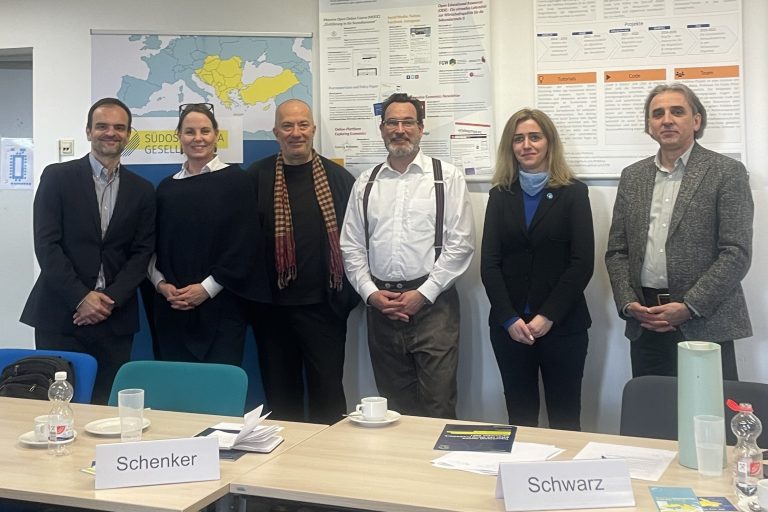
On February 23, 2026, the University of Duisburg-Essen hosted a panel discussion marking the 25th anniversary of the Ohrid Framework Agreement (OFA). The event brought together academics, media professionals, and policy experts to reflect on the long-term political and institutional developments in North Macedonia since 2001.
Among the speakers, from academia, Dr. Veli Kreci and Dr. Albulena Halili from the Max van der Stoel Institute at South East European University, contributed with their research-based insights into the evolution of governance structures, decentralisation process, and institutional performance in the post-2001 period.
The discussion focused on the achievements and limitations of the OFA as a constitutional framework that preserved stability and institutionalised power-sharing in a fragile multiethnic society. Particular attention was given to the balance between political compromise and democratic consolidation, as well as to the challenges of strengthening institutional credibility and public trust over time.
A key emphasis of the panel was the academic reassessment of the OFA beyond commemorative narratives. While the Agreement succeeded in preventing renewed conflict and normalising inclusive governance, speakers also highlighted that its implementation remains uneven in certain areas. Ongoing debates over equitable representation, decentralisation, and institutional autonomy demonstrate that the OFA continues to shape political discourse. The persistence of parallel narratives among major communities regarding the events of 2001 further illustrates that institutional settlement does not automatically translate into broader societal convergence.
The event was organised by the Duisburg branch of the Southeast Europe Society at the Institute of Political Science in cooperation with Pro Peace. It was kindly supported by the State Chancellery of North Rhine-Westphalia and took place within the framework of the strategic partnership between North Rhine-Westphalia and the Republic of North Macedonia.
The discussion provided a valuable platform for scholarly exchange within a broader European context and strengthened academic cooperation between participating institutions. The lively engagement underscored the continued relevance of the Ohrid Framework Agreement for contemporary debates on governance, institutional reform, and democratic resilience in Southeast Europe.